







Financial Literacy

1. Money is a universal language, but its value is understood differently across borders.
2. An investment in knowledge pays the best interest.
Financial Literacy - Activity 1
Money is a universal language, but its value is understood differently across borders.
Classes: XI & XII
Exploring Global Currencies: A Journey into Financial Literacy
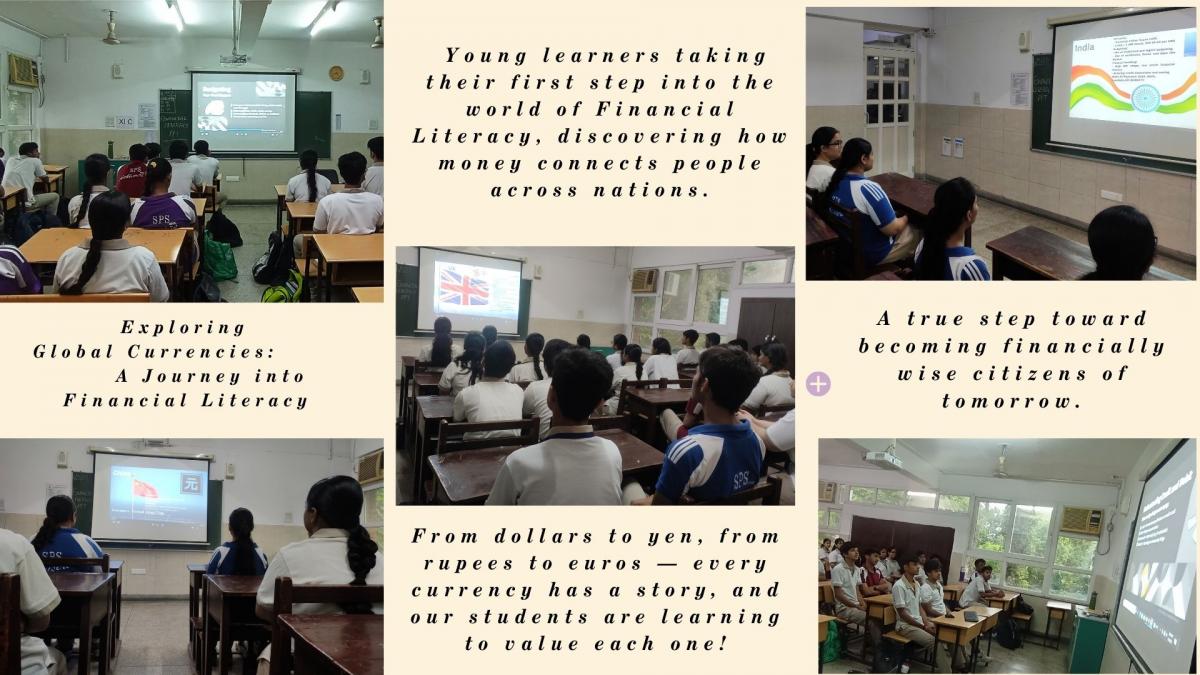
As part of the international project Financial Literacy – Decode the Money Code, the school hosted an enriching session for Classes XI and XII. The programme was designed in collaboration with partner schools in the UK and Japan, and further enriched with perspectives from the UAE, China, and India. This cross-cultural exchange gave students an opportunity to view money not only as a medium of exchange but also as a bridge connecting economies, cultures, and everyday lives across the globe. During the session, students engaged with a presentation on world currencies and currency conversion, which brought to light the dynamic value of money across different nations. They discovered how exchange rates influence international trade, travel, and daily transactions, linking classroom knowledge directly to real-world applications. The interactive nature of the session encouraged students to compare, question, and reflect on the role of financial literacy in an increasingly interconnected global economy. The event served as the first step in a series of activities under the project, setting the foundation for a broader understanding of finance that is not only academic but also practical, cultural, and global in scope.
Learning Objectives:
- introduce students to the concept of global currencies and exchange rates.
- link classroom knowledge of economics with real-world financial practices.
- highlight the importance of financial literacy in international trade and travel.
- build awareness of how money functions differently across countries and cultures.
- encourage students to think critically about financial systems beyond their nation.
- foster curiosity and respect for diversity through global financial perspectives
Learning Outcomes:
- Students gained an understanding of global currencies and their conversions.
- They learned to appreciate how exchange rates affect trade, travel, and everyday life.
- They developed the ability to connect classroom economics with real-world practices.
- They became more confident in approaching financial matters with awareness and adaptability.
- They recognised the global nature of financial systems and the value of cultural perspectives in money management.
--------------------------------------------------------------------------------------------------
Financial Literacy - Activity 2
An investment in knowledge pays the best interest.
Class XI & XII
Mock Stock: Turning Classrooms into Trading Floors
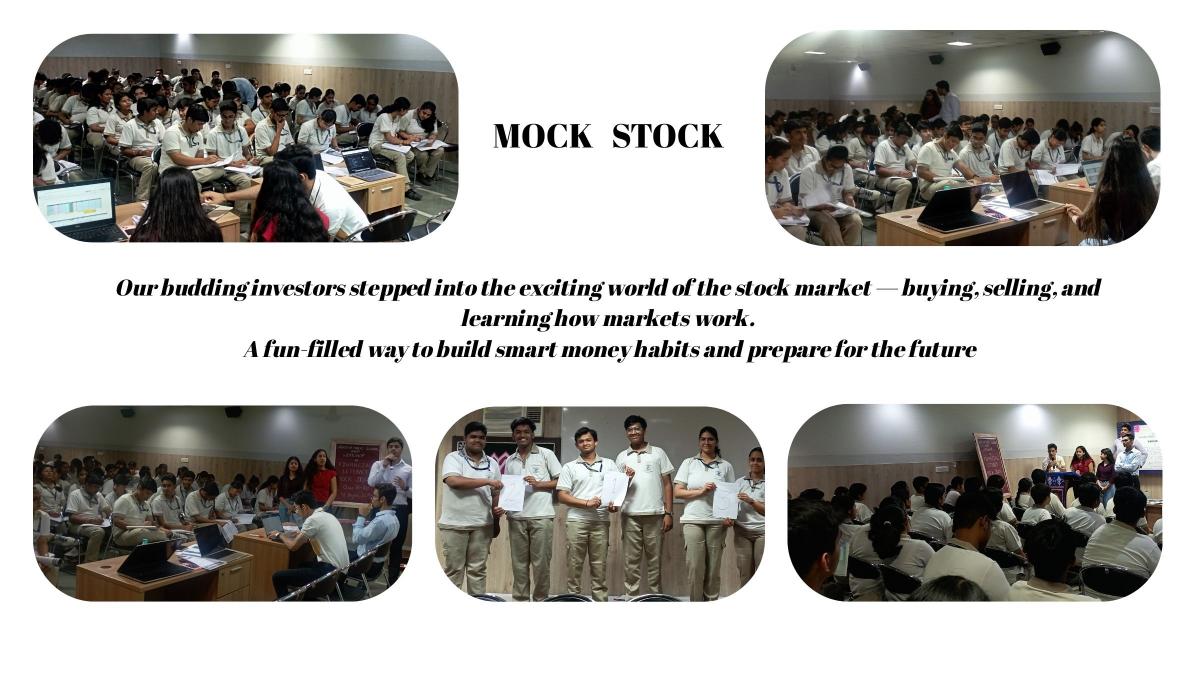
In a lively blend of classroom theory and real-world practice, students of class XI and XII recently stepped into the fast-paced world of a simulated market, where lessons leapt off the page and into action. The high-energy buzz of a stock exchange during the school’s first-ever Mock Stock event brought financial concepts to life in the most dynamic way possible. Working in teams, the students stepped into the roles of traders, each starting with a virtual capital of ₹10,00,000. Their challenge was to buy, sell, and even short-sell shares of seven fictional companies, along with trading three commodities: gold, silver, and crude oil.
The event was a part of the Financial Literacy – Decode the Money Code initiative. the simulation aimed to build not only financial knowledge but also the ability to make informed and responsible economic decisions. Over three fast-paced rounds, the market price shifted swiftly based on breaking news and market rumours,” forcing participants to adapt strategies on the fly, analyse data quickly, and work closely with their teammates.
The experience brought classroom lessons to life, connecting them directly with the hustle and excitement of real-world markets. It not only nurtured a positive attitude towards managing money but also deepened students’ appreciation for economic diversity. Along the way, they sharpened their communication, strategic thinking, and grasp of global financial trends.
By the close of the simulation, generously supported by an alumnus-led company, students left with more than just knowledge. They carried sharper budgeting and analytical skills, stronger teamwork, and a newfound confidence in tackling financial challenges. The shared sentiment was clear: learning about finance isn’t just important; it can be exciting, eye-opening, and genuinely transformative.
Learning Objectives:
- Bridge the gap between classroom knowledge and practical application
- Help students experience the real-world dynamics of trade, budgeting, and resource allocation.
- Develop financial decision-making and budgeting skills in a risk-free, engaging environment.
- Foster critical thinking, adaptability, and collaborative problem-solving.
- Build awareness of market diversity and the interconnectedness of local and global economies.
- Strengthen communication and negotiation abilities through peer-to-peer interaction.
Learning Outcomes:
- Students gained sharper financial skills
- They learned to approach money management with a balanced, informed perspective.
- Analyse and respond to changing market conditions effectively.
- Collaborate efficiently within a team to achieve shared goals.
- Recognise the value of strategic planning and resource optimisation.
Financial literacy is not just about earning money, but about learning to make money work for you
Classes: XI & XII
Activity: Shaping Smart Investors of Tomorrow
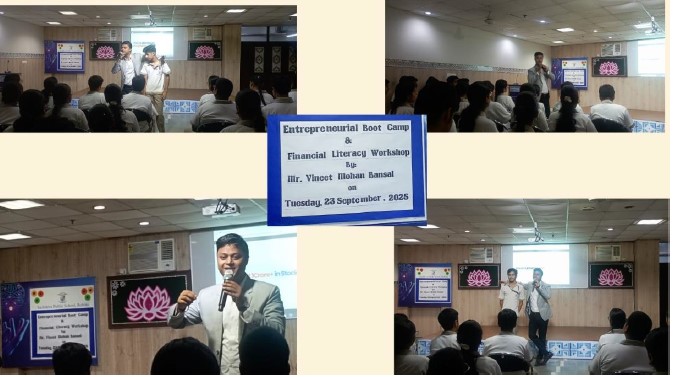
As part of the Financial Literacy initiative, students attended an insightful session conducted by entrepreneur Vineet Bansal, who provided practical knowledge on saving, insurance, investments, and digital finance and engaged students deeply with real-world financial concepts.
During the session, they learned about the importance of disciplined saving, the role of insurance in securing one’s future, and how smart investments can create long-term wealth. Mr. Bansal also introduced them to the rapidly evolving world of digital payments and online financial tools, helping students understand how technology is reshaping money management in today’s economy.
For the students, the session was highly enriching and immediately useful. They discovered how to evaluate financial risks, compare investment options, and make informed decisions instead of impulsive ones. The interaction also boosted their confidence, encouraged them to think proactively about their financial goals, and helped them appreciate the need for financial planning from a young age. Overall, the session empowered students with practical, actionable knowledge—turning financial literacy from a textbook topic into a life skill they can carry confidently into the future.
Budgeting is not about limiting yourself—it is about making yourself free.
Classes: XI & XII
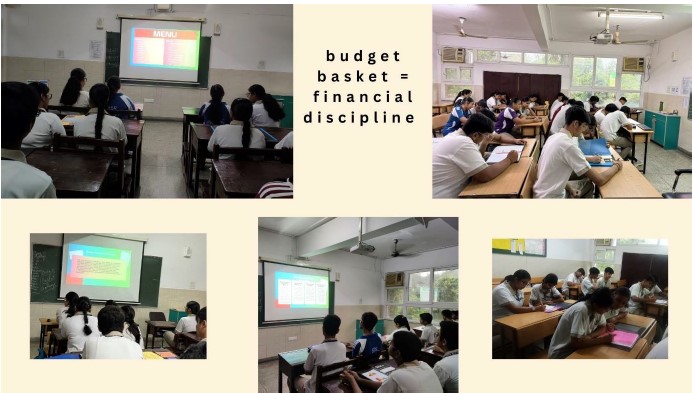
Activity: Budget Basket Challenge
As part of the school’s ongoing Financial Literacy initiative, students participated in the Budget Basket Challenge, an engaging activity designed to build practical money-management skills. Each student group received a mock budget along with a printed shopping menu, challenging them to make thoughtful purchasing decisions while staying within their financial limits.
The activity was conducted to help students understand the real-world importance of financial planning, prioritisation, and resource allocation. By analysing costs, comparing options, and recording their expenditure, students learned how to manage a budget effectively—an essential life skill.
Through the preparation and presentation of their expense reports, they developed not only financial discipline but also critical thinking, teamwork, and decision-making abilities. The challenge taught them to differentiate between needs and wants, optimise limited resources, and recognise how small choices can impact overall financial outcomes.
Smart choices today, stronger futures tomorrow
Classes: XI & XII
Activity: The Big Ad Battle-Student Innovation Challenge
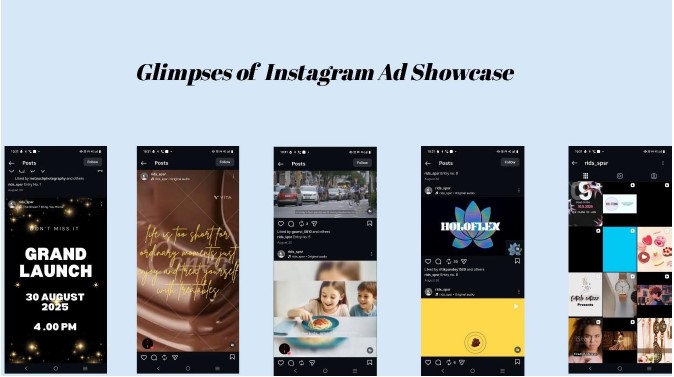
As part of the RIDS Financial Literacy initiative, students took part in an engaging advertisement-making activity where they created 60–90 second ads promoting a product, smart saving habits, or digital payments. This creative experience helped them understand how advertisements influence consumer behaviour and how financial choices are shaped by persuasive messaging. Through this activity, students connected financial concepts with real-world communication in a fun and meaningful way.
The students’ excitement was clearly visible as they discussed ideas with their teams, planned their scripts, and recorded their visuals. They enjoyed exploring different ways to make their messages engaging, informative, and relatable. The highlight for many was seeing their advertisements posted on Instagram, which gave them a sense of pride and ownership. The online voting for the best advertisement further added an element of friendly competition, motivating them to put in their best efforts.
To ensure safety and responsibility throughout the process, parents submitted a detailed NOC that outlined key guidelines for participation. All content was created under teacher and parent supervision, with scripts and visuals approved beforehand to maintain educational value and age-appropriate messaging. Students’ privacy was protected, with comments disabled and posting done only through the teacher-managed Instagram account using unique codes for voting. The advertisements were displayed online only within the permitted time window, and the entire initiative remained strictly educational and non-commercial. This well-structured system allowed students to participate confidently and enjoyably, blending creativity with financial understanding in a safe and guided environment.
Financial literacy is not just about earning money, but about understanding its value, making wise choices, and giving back to society.
Classes: XI & XII
Activity: Mini Market Marvels- Decode the Money Code
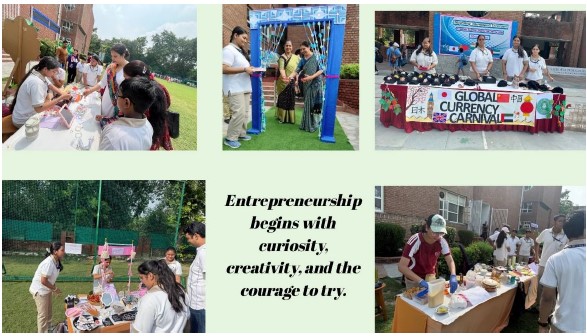
The students transformed the campus into a vibrant Mini Market under the Financial Literacy Programme – Decode the Money Code. What blossomed was far more than a marketplace; it was a colourful celebration of creativity, enterprise, teamwork, and practical learning.
The Mini Market buzzed with excitement as students showcased a wide range of innovative stalls. From refreshing lemonade and perfectly brewed coffee to handmade jewellery, bookmarks, caps, snacks, and artful craft items, every stall reflected the passion and dedication of the young entrepreneurs. The delicious aroma from food counters, the charm of handmade accessories, and the cheerful energy at game stalls created an atmosphere filled with learning and joy. Merchandise stalls offering caps, keychains, and magnets added vibrancy, while self-prepared perfumes, chocolates, and craft items proved to be major attractions for visitors.
A special highlight of the event was the Global Currency Booth, where students creatively introduced peers and parents to the currencies, cultures, and traditions of Japan, the UK, the UAE, and China. It became a space where geography, economics, cultural studies, and global awareness blended seamlessly into an engaging learning experience.
The event coincided with the Parent-Teacher Meeting, giving parents a wonderful opportunity to witness how effectively classroom concepts turn into real-life skills. Many parents were delighted to see their children independently handling planning, budgeting, selling, customer interaction, and teamwork. One parent remarked, “It is wonderful to see classroom concepts come alive like this. The confidence and creativity of students is truly inspiring.” Their appreciation added to the students’ confidence and joy.
The Mini Market stood as a living lesson in entrepreneurship, financial literacy, communication, cultural awareness, and compassion. Students not only learned to organise, collaborate, and make decisions but also strengthened leadership skills and developed an understanding of fair trade and social responsibility. Adding meaning to their efforts, students pledged 20% of their proceeds (₹500) to charity—proving that true profit lies in purpose.
What remained at the end of the day was not just empty stalls, but hearts full of learning, teamwork, gratitude, and pride—reminding everyone that education is most powerful when students learn by doing.
Financial literacy is the foundation of a secure future.”
Classes: XI & XII
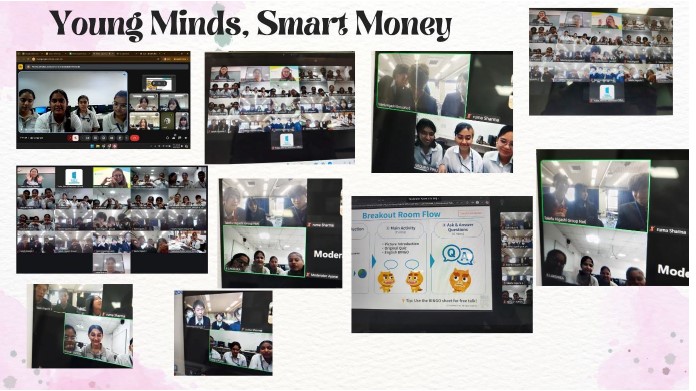
Activity: Decode the Money Code – International Video Conference
Students of Classes XI and XII participated in an engaging international video conference with Takefu Higashi High School, Japan as part of the initiative “Decode the Money Code”, aimed at promoting financial literacy among young learners. The interaction created an excellent platform for students from both schools to connect, exchange ideas, and understand how financial awareness plays an important role in shaping responsible and informed citizens.
During the session, students proudly shared the projects they had prepared on financial literacy, highlighting topics such as saving, budgeting, responsible spending, and smart financial decision-making. They also presented a Mini Market video and PowerPoint presentation, demonstrating how students can learn practical money management skills through simulated market activities. These presentations helped illustrate real-life financial concepts in an engaging and relatable manner.
To encourage participation and global interaction, students also invited their international peers to view and vote for their creative Instagram advertisement campaign designed to promote financial awareness among youth. The exchange of ideas and presentations created a lively and meaningful dialogue between students from both countries.
The session strengthened students’ confidence, communication skills, and global outlook, while helping them understand the importance of financial literacy in everyday life. By sharing projects and learning from one another, students realised that responsible financial habits and informed choices are essential for building a secure and sustainable future.